
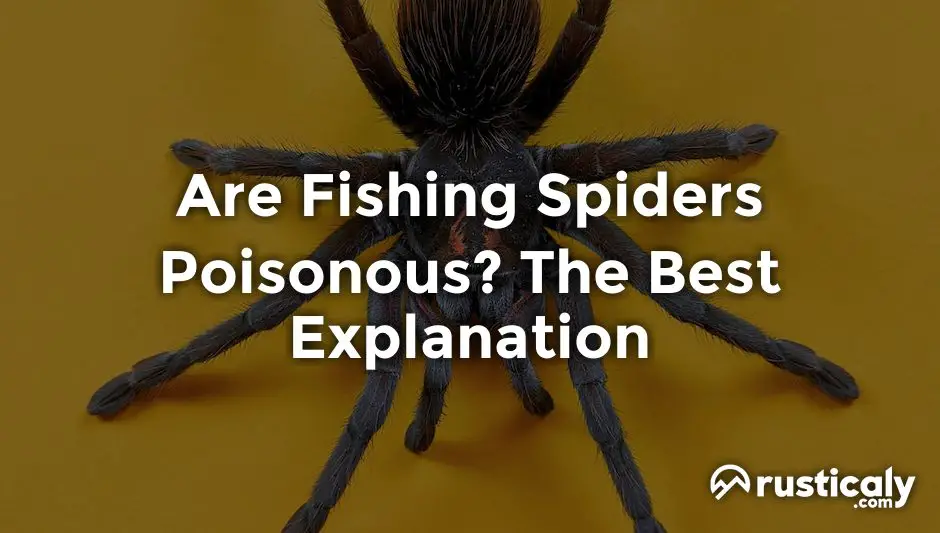
They are shy in nature and don’t bite unless absolutely necessary. The sting is the same as a wasp sting and the bite is not detrimental at all. They are not venomous, but they can sting if they feel threatened.
Table of Contents
Is a fishing spider a wolf spider?
Fishing spiders are often brown and gray with banded patterns on their legs. Wolf spiders are usually light brown, dark brown, gray, or tan, and they frequently have a stripe running down their backs in a lighter or darker color. Wolf spiders may have more than one pattern on their body.
Wolf spiders can be found in almost any part of the world, but they are most common in the United States and Canada. They are also found throughout Europe, Asia, Africa, the Middle East, South America, Australia and New Zealand.
Do fishing spiders live in your house?
Near bodies of water, fishing spiders are typically found around lakeside vegetation, boat docks, and other structures. They are also known to be found in wooded areas and along roadsides. In the wild – (See list below)
- Mussels
- Clams
- Oysters
- Crabs
- Snails
- Sea urchins
- Worms
- Mollusks
- Fishing spiders feed on small fish
- Crustaceans such as crayfish
- Fish eggs
- Larvae
as well as other small invertebrates.
The majority of their diet consists of insects, but they will also eat small mammals, birds, reptiles, amphibians and fish.
Where does the fishing spider live?
Individuals are also found in dark and damp places beneath bridges or culverts. D. trifasciatus is not known to be harmful to humans. It can also cause damage to trees and shrubs.
Where do fishing spiders go in the winter?
Some spiders, like the fishing spider and the tarantula, live longer than a year and will hibernate during the cold months.
Spiders can be found under tree bark, rocks, between the ground and the snow, or even in the soil. Hibernating spiders are not dangerous to humans, but they can be a nuisance to gardeners, especially if they are attracted to your plants.
If you see a spider in your garden, don’t be afraid to call the police.
What attracts spiders in your house?
Some spiders are attracted to moisture, so they take shelter in basements, crawl spaces, and other damp areas inside a home. Air vents, high upper corners of rooms, and attics are some of the environments other spiders prefer. House spiders spend their entire life cycle in a single room. Spiders are also known as house-dwelling spiders because they live in the same room as their host.
House spiders can be found in almost every room of the house, including the bathroom, kitchen, living room, bedroom, dining room and even the basement. The house spider is the most common type of spider in North America and is found throughout the United States, Canada, Mexico, Central and South America, Europe, Asia, Australia, New Zealand and Oceania.
Where do fishing spiders come from?
It’s a common household invader in wooded areas and the species is more accurately classified as a tree-dwelling spider. The spider is about 1/4 inch (1.5 cm) in length and has a reddish-brown body with black markings on the abdomen. The legs are dark brown to black with a black stripe running down the middle of each leg.
Do dark fishing spiders carry their babies?
She has carried it around since she formed it, and she will conceal it when it’s about time for the eggs to hatch so that the spiderlings don’t get hurt.”. So you’re telling me that you’ve been keeping it for a long time, but you haven’t been able to get it to lay eggs?”
I’m not sure if that’s true, or if you were just trying to keep it a secret from me. I think it would be a good idea for you to give it back to me, so I can take care of it myself. You’re the one who’s going to be the father of my children, after all.”
I said, trying my best not to show any emotion as I spoke. I knew that if I did, it wouldn’t go over well with either of them. After all, they were the ones who had taken me in when I was just a baby.